Acrylic Stucco Tones: Modern Exterior Trends for Edmonton Neighborhoods
Acrylic Stucco Tones: Modern Exterior Trends for Edmonton Neighborhoods
Acrylic stucco gives Northwest Edmonton homes and commercial buildings a clean, modern look that stands up to harsh winters. Property owners across Castle Downs, Big Lake, The Palisades, and Griesbach are asking for resilient finishes with strong colour retention and subtle textures. This article looks at acrylic stucco tones that suit local streetscapes, shows how finishes perform in Alberta freeze-thaw cycles, and explains where EIFS and acrylic pair best. The framing aligns with so readers comparing options can move forward with confidence.
Local conditions drive every decision. Edmonton swings from -30°C in January to +30°C in July. Walls expand and contract. Traditional cement plaster stucco cracks under that stress. Acrylic stucco, which uses an acrylic resin binder with fine sand and pigments, flexes slightly and resists hairline cracking. That flexibility, combined with colour-stable finishes, is why acrylic dominates new residential cladding in Big Lake communities like Hawks Ridge and Trumpeter and in mixed-use blocks near 97 Street and 137 Avenue. For projects that need higher insulation and air-sealing, Exterior Insulation and Finish Systems (EIFS) with an acrylic finish coat deliver continuous insulation and a broad colour palette with textures that match anything from a fine sand float to a smooth Santa Barbara finish.
Why acrylic stucco makes sense in Northwest Edmonton
Two realities shaped today’s exterior choices in Northwest Edmonton. First, Edmonton’s intense freeze-thaw cycling widens small cracks. Second, homeowners have become more energy conscious since the 2000s. Between 2000 and 2004, Alberta builders shifted away from portland-cement hard-coat stucco on homes and toward EIFS with acrylic finishes. EIFS adds R-3 to R-5 per inch of insulation value and reduces air infiltration by up to about half compared to brick or wood. For streets near Anthony Henday Drive and along Yellowhead Trail, where wind load and winter exposure are serious, that performance matters.
Acrylic stucco, sometimes called California stucco, can be a finish system over a wire-lath base coat or the topcoat over an EIFS assembly. Acrylic’s resin binders carry colour evenly and handle micro-movement from daily temperature swings. That helps homes in Castle Downs communities like Beaumaris and Caernarvon keep their finish intact longer, instead of spiderweb cracks appearing after a deep February cold snap. The change is visible across T5X and T5Y postal codes, where newer blocks with acrylic finish tones show consistent, even colour several seasons in a row.
The tone families that work on Edmonton streets
Colour is not just taste. It controls thermal load, hides or shows dust, and frames the home’s trim and stonework. In neighborhoods across Castle Downs Road and 153 Avenue, balanced neutrals and grounded earth tones pair well with mature trees and larger 1970s-1980s lots. In Big Lake areas adjacent to Lois Hole Centennial Provincial Park and Big Lake, cool greys and soft whites mirror the lighter modern architecture. The following tone families have been performing well under Edmonton sun and winter glare.
- Warm off-whites and creams: ivory, soft parchment, warm white that stays bright in winter but does not glare under snow.
- Greige and taupe: light greige, sandy taupe, and mushroom hues that hide dust and road film along 97 Street.
- Charcoal accents: deep charcoal or nearly black used on bays or upper gables, matched with light field colours for contrast.
- Muted greens and blues: silvery sage and steel blue that fit Griesbach’s lakes and open spaces without looking dated.
- Brick-paired tones: soft tan and light grey that blend with thin brick or manufactured stone veneer wainscots.
Edmonton light is sharp in winter. Brilliant whites can look stark against snowbanks. Warm whites with a hint of cream keep façades from feeling cold. On the other side, dark tones look striking but heat fast in summer and can show efflorescence if the wall system traps moisture. That is one reason EIFS with a proper drainage plane and liquid-applied water-resistive barrier (WRB) matters under dark acrylic finishes. The drainage plane sheds incidental moisture so pigment remains even and the base coat does not telegraph blotching.
Texture choices: from float-fine to Santa Barbara smooth
Texture controls shadow lines, dirt visibility, and how well repairs blend years later. An acrylic float finish uses fine sand and gives a subtle, uniform look. A medium sand finish hides small substrate waviness from older sheathing in Castle Downs bungalows and two-storeys. A Santa Barbara finish, which is a semi-smooth look with small sand particles, reads modern and pairs well with black-framed windows found in new Griesbach infill. A lace or skip-trowel texture can disguise minor imperfections on older cement plaster stucco. Many 1970s homes in Carlisle and Dunluce have inconsistent studs and sheathing that show through a smooth finish. In those cases, a fine to medium sand acrylic finish looks straight even on a wall that is not laser-flat.
Acrylic finishes install as a thin, even coat over a primed base coat or over an EIFS reinforced base coat with fibreglass mesh. Texture is set by trowel technique and aggregate size. Local crews can match most existing textures by mixing small test batches to check sand size and pigment. For projects that include a colour change plus texture refinement, an elastomeric stucco coating can bridge microcracks and level small texture differences before the acrylic finish goes on. Elastomeric coatings are more common for recoats on older T5W and T5L properties that need flexible sealing rather than a full re-skim.
Neighbourhood-specific palettes that fit the streetscape
Castle Downs has a unique naming heritage built on European castles. Beaumaris, Baturyn, and Caernarvon contain large-lot homes from the 1970s and 1980s. Many of these houses carried original cement plaster in tan, cream, or pinkish tones that faded. When owners re-clad or recoat with acrylic, the best results hold to a warm base with a modern accent. Light greige field colour with charcoal window surrounds and warm white trim looks current without clashing with adjacent homes that have older siding or brick. Where stone veneer is present on front entries, the tone should pick up a mid-value neutral that ties both materials together.
Big Lake neighborhoods like Trumpeter and Hawks Ridge feature newer builds and sharper rooflines. Lighter field tones with deep, single-plane accents work here. Soft white or pale grey on main walls with a black or charcoal upper gable reads contemporary. It also photographs well under the big sky near Lois Hole Centennial Provincial Park. Because wind exposure is higher out by Ray Gibbon Drive and the Henday, EIFS with acrylic finish coats is common in this zone. The lighter tones prevent heat buildup on sunny west elevations that could stress sealants around expansion joints and flashing.
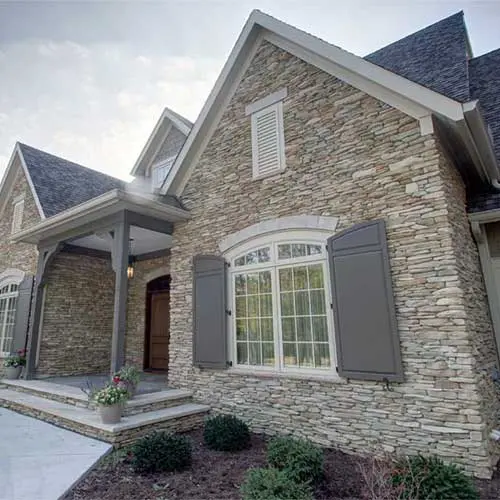
Griesbach carries a planned heritage feel. Canada Lands Company designed the community for balanced streetscapes around Griesbach Lake and the community gardens. Homes here handle deeper historical tones well. Olive-tinged greys, muted navy, and off-white trim complement brick and stone details. Acrylic finishes accept custom pigmentation that remains stable for years, which helps multi-block consistency along 97 Street and 153 Avenue. The area’s LEED ND planning goals also align with EIFS assemblies that add exterior insulation and reduce thermal bridging through stud walls.
In The Palisades, including Oxford, many homes date from the 1990s. These homes benefit from acrylic recoats that unify colour across additions and repairs. Warm beige and mid-grey blends work with attached garages and front-facing gables common to this era. Where previous stucco painting failed and shows chalking, a breathable acrylic latex primer followed by a high-build elastomeric coating can create a suitable base for the final acrylic finish.
Performance and durability in Alberta conditions
Finish tone is not separate from performance. Darker colours absorb more heat. That raises the temperature swing the assembly must handle. Control joints and expansion joints around large wall sections manage movement. Proper sealant with backer rod at window perimeters prevents water ingress where siding meets frames. A weep screed at the base of the wall lets incidental moisture exit. These details protect colour uniformity. Blotchy walls are often a symptom of moisture behind the finish coat, not a pigment defect.
At the substrate level, a liquid-applied WRB or a sheet-applied WRB sits over sheathing. On EIFS, EPS or XPS insulation boards are adhered or mechanically fastened, then embedded in a fibreglass-reinforced base coat. A primer and acrylic finish coat complete the system. Drainable EIFS includes vertical grooves or spacer mats to create a drainage plane. This drainable approach solved the 1990s moisture issues that created skepticism about early EIFS. The finish tone stays even because the base coat remains dry and stable. Service life for a properly installed acrylic finish over EIFS can reach 25 years before an aesthetic refresh is desired.
Cost ranges for 2026 projects in Edmonton
Budgets vary by building size, access, and architectural detail. For Northwest Edmonton in 2026, acrylic stucco installation typically ranges from $9 to $15 per square foot. That price includes the finish materials and labour for standard conditions. EIFS with acrylic finish generally falls between $8 and $15 per square foot on standard homes, and $12 to $20 per square foot on complex elevations with multiple returns, cornices, or intricate trim. Recoating older stucco with elastomeric coatings usually ranges $5 to $7 per square foot when substrate is sound. Texture-matching premiums can add $2 to $6 per square foot when custom blending is required to disguise previous patterns or inconsistent sand size.
Winter work costs more when hoarding and heat are necessary. Upper-storey access can add scaffold costs in the range of a couple hundred dollars when lifts are not practical on tight Castle Downs cul-de-sacs. Written quotes should separate substrate repairs from finish costs. If moisture has damaged sheathing or if flashing must be rebuilt, that work is separate from the finish coat installation.
New builds, re-clads, and mixed-material façades
New construction in Hawks Ridge and Starling often uses EIFS for energy performance. Designers specify continuous insulation to reduce thermal bridging and call for acrylic finishes to achieve consistent tone across complex façades. Where manufactured stone veneer meets acrylic stucco, details like proper step flashing above stone caps and a drip edge over horizontal transitions prevent staining. For homes built in the 1990s around Oxford and Rosslyn, owners often replace aged cement plaster with a drainable EIFS assembly and a fresh acrylic finish. The new wall drains, the R-value increases, and the colour remains stable longer.
Commercial fronts near 137 Avenue and 97 Street benefit from acrylic finishes with higher abrasion resistance topcoats in high-traffic zones. Entry columns and parapets can be detailed with cement board stucco where impact is likely, while EIFS with acrylic finish covers upper walls. The tone stays consistent across systems because acrylic pigments and texture are matched.
Shareable local insight: why certain Castle Downs stucco ages all at once
Many Castle Downs homes were built during a 1970s-1980s boom and used cement plaster stucco. The 2000-2004 industry shift away from cement plaster toward EIFS means those older walls reached the same stress-related age at roughly the same time. A single tough winter can push many of them from “fine” to “flawed” together. That is why whole streets in Beaumaris, Baturyn, and Dunluce may show fresh acrylic finishes within a two-year span. Neighbourhood-wide ageing is less about coincidence and more about the original construction wave and Edmonton’s freeze-thaw rhythm.
Scheduling and seasonality along the Henday and Yellowhead corridors
Acrylic and EIFS work needs dry conditions and above-freezing temperatures during application and cure. Most field crews aim for spring through early fall. Wind corridors near Anthony Henday Drive can dry finishes too quickly on hot days, so crews adjust mix and timing to prevent premature skinning. In late fall, heat and hoarding keep work moving, but owners should expect a modest cost increase for temporary enclosures and propane. Along Yellowhead Trail, dust levels can be higher. Walls are washed and primed carefully before finish coats to prevent adhesion issues that could show as blotching under low winter sun.
Texture and tone with other envelope elements
Acrylic stucco is part of a larger envelope that includes roofing, windows, and foundation parging. On many Northwest Edmonton homes, the lower 18 to 24 inches of façade carry stone or parging. If parging is crumbling, it telegraphs neglect even when the wall tone is perfect. Parging repairs typically run $5 to $10 per square foot and can be scheduled with acrylic finishing to keep the exterior consistent. While some owners search how to repair a cracked foundation, most exterior cracks at grade are parging failures, not structural foundation issues. A site visit clarifies the difference. True foundation repairs are structural and involve different trades and engineering. Parging is a protective coat for concrete exposed to splashback and frost.
Details that protect colour and finish for the long term
Three details control finish longevity. First, expansion and control joints must be where design and substrate require. Second, step flashing and counter flashing at roof-to-wall and at deck terminations must be watertight. Third, the weep screed at the base of stucco or EIFS walls should not be buried by landscape soil or paving. When these are correct, acrylic tones stay even across seasons and maintenance is simple. For darker tones used on southwest elevations in Westmount and Woodcroft, owners can consider a slightly lighter shade to reduce thermal stress on sealant lines at window perimeters and corners.
Warranty framework and what it means for tone selection
EIFS manufacturers typically provide a 5-year material warranty when systems are installed to specification, including proper WRB detailing, mesh embedment, and primer-to-finish steps. Installers add a workmanship warranty that covers application quality. Warranties do not cover colour selection, but they do expect environmental suitability. Excessively dark tones on thin-wall assemblies without drainage can void expectations around finish performance. That is why drainable EIFS with a mid-value tone is a common pairing in exposed sections off 153 Avenue and Castle Downs Road.
Examples by corridor and lot type
In Athlone and Calder, many properties present early mid-century massing with modest eave projections. A medium sand acrylic finish in a warm neutral supports the architecture. Rain splash is higher on these shallower eaves, so elastomeric base coats under the finish are common. On deeper-lot homes in Carlisle and Canossa, bolder two-tone combinations work because façades have more surface to break up. The field tone can be a light greige with a charcoal garage pop-out. Cornices and window surrounds should be matched carefully if stucco mouldings are present. Acrylic finishes can coat synthetic mouldings and maintain uniform sheen across profiles.
For St. Albert-adjacent properties along St. Albert Trail and Ray Gibbon Drive, wind-driven rain and dust are bigger factors. A fine to medium float finish hides grime and washes easily. Where thin brick is used as a belt course at mid-wall, seal joints with compatible caulking and backer rod, then continue the acrylic finish above with a slight tone shift to make the brick stand proud. Manufactured stone veneer at entries should sit on proper drainage mats and have weep paths. This prevents water from wicking into acrylic finishes and staining the tone.
Installation stack that supports beautiful tones
Successful colour starts at the substrate. A straightforward, Edmonton-ready assembly for EIFS with acrylic finish looks like this. Sheathing receives a liquid-applied water-resistive barrier that doubles as an air barrier. EPS insulation boards are adhered in a staggered pattern to reduce seams. Mechanical fasteners are added where wind loads require, which is common for homes open to Big Lake breezes. Fibreglass reinforcement mesh is embedded in a base coat that encapsulates the foam. Corners and openings receive diagonal mesh patches to resist cracking. A tinted primer prepares the surface so the acrylic topcoat covers evenly and matches the selected tone without blotching. The acrylic finish coat is then trowel-applied to the chosen texture. Control joints align with substrate breaks and architectural lines. Weep screeds are clear at the base, with finished grade held down to avoid bridging the drainage path.
On wire-lath acrylic systems without exterior insulation, similar principles apply. A sheet or liquid WRB covers sheathing, wire lath is fastened in accordance with stud layout and wind loads, and a cementitious base coat is applied. After cure, the acrylic primer and finish coat deliver the colour and texture. In both systems, sealant joints at window and door perimeters are installed with backer rod to control depth and ensure proper movement capability of the sealant. These basics keep tones crisp from T5T to T5X postal runs.
Maintenance and refresh timelines
Most acrylic finishes look strong for 10 to 15 years before owners consider an aesthetic update, especially on south and west elevations. In shaded lanes off 127 Street and 137 Avenue, finishes last longer because UV exposure is lower. When hairline cracking appears on older cement plaster or on patched areas, an elastomeric stucco coating can bridge microcracks before a colour change. Many owners schedule a full clean, seal, and recoat in the 8 to 15 year window. Breathable acrylic latex primers help control moisture, and the finish coat refreshes tone without trapping water.
Common pitfalls when choosing tones and textures
There are three frequent mistakes. The first is picking a tone in a showroom without viewing a large field sample in outdoor light. Edmonton’s sky changes quickly. A tone that looks warm indoors can read cold outside. The second is selecting an ultra-smooth finish on older walls. Smooth reads great on a new EIFS plane. It can look wavy on old sheathing. The third is ignoring adjacent materials. Metal roof cladding, window frames, and stone veneer all influence tone. The best Northwest Edmonton façades read as a single design with tone harmony across parts, not as isolated selections.
How acrylic tones interact with masonry and stone
Manufactured stone veneer, cultured stone, and thin brick are common in The Palisades and Griesbach. Acrylic stucco tones should either complement or contrast cleanly. A safe rule locally is to pick up a mid-tone from the stone or brick field for the stucco, then reserve darker tones for small areas. Where natural stone is cool grey, a warm white acrylic finish can look chalky. In that case, choose a neutral white with a small grey component so façades feel cohesive. Drip edges above stone caps and correct step flashing stop water that can stain the stucco and distort colour.
Why Edmonton’s climate favours EIFS under acrylic finishes
EIFS assemblies evolved for cold, wet climates after postwar reconstruction in Germany. Edmonton needed that same solution. An EIFS wall increases R-value continuously across studs and reduces drafts through the building envelope. On a windy day off Yellowhead Trail, that reduction is immediate. The acrylic topcoat then rides over a stable, insulated base. The result is fewer hairline cracks, better colour retention, and less thermal stress on sealant and joints. EIFS is also lightweight, about 2 pounds per square foot, which reduces structural load and helps during retrofits on older walls in Prince Charles and Sherbrooke Wellington.
Project planning checklist for tone success
- Confirm system: EIFS with acrylic finish or wire-lath acrylic finish based on performance goals.
- Select texture that hides or highlights as needed, from fine float to Santa Barbara smooth.
- View large outdoor samples along 97 Street light conditions morning and afternoon.
- Coordinate tones with windows, roofing, and any stone veneer or thin brick.
- Set expansion joints, flashing, and weep screeds ahead of colour decisions to prevent later compromises.
Why acrylic tones are winning Edmonton market share
Owners want façades that look good longer and handle seasonal shifts. Acrylic finishes provide that balance. They absorb slight wall movement without mapping cracks across the surface. Manufacturers provide pigments that hold up under UV. When installed over a drainable EIFS assembly with a proper liquid-applied water-resistive barrier, acrylic finishes give consistent, stable colour from spring thaws to early winter frosts. That is why a walk around Griesbach Lake or down Oxford’s residential lanes shows more acrylic finishes each year.
Northwest Edmonton case notes from site crews
Crews working near T5T and T5X routes report smoother application windows on calm mornings due to wind off Big Lake picking up later in the day. They also adjust finish mix on hot afternoons so the trowel time stays consistent and edges are clean. Along 153 Avenue and Castle Downs Road, road dust requires a more thorough wash before primer. This small detail prevents failures where primer adheres to dust, not the base coat. Where homes back onto parks, irrigation overspray can dampen walls in the morning. Scheduling finish coats after noon avoids trapped moisture under fast skins of acrylic.
What readers researching should take from tone selection
Whether a project involves new acrylic stucco installation, an EIFS retrofit with an acrylic finish, or a recoat, tone selection must match both architecture and system performance. A colour that looks ideal in a vacuum may underperform on a wall with the wrong drainage or control joints. Projects that begin with a clear system choice and detail-first approach end with acrylic tones that age evenly.
How tone choices intersect with city planning and value
Northwest Edmonton has a wide range of housing eras, from early postwar bungalows in Dovercourt to new construction near Big Lake. Thoughtful tone selection respects streetscape history while presenting a fresh look that buyers in the Edmonton metro want. Acrylic finishes provide virtually unlimited colour options, which allows owners to align with community design guidelines where present. In Griesbach, where heritage-inspired plans guide façades, neutral field colours with historically accurate accents fit that context and support resale value. In newer Trumpeter streets, cooler palettes with high-contrast trim mirror current buyer preferences.
Why tone samples matter more in Edmonton than in many cities
Low winter sun and high summer daylight make Alberta colours shift more dramatically than in milder climates. Shadows fall longer in December. Snow cover raises reflected light that can wash out pale tones. Sampling colours on site along 97 Street or 137 Avenue at two times of day gives a truer read. It also shows how the acrylic finish texture will scatter light. A fine float finish throws softer shadows than a medium sand finish. That difference can be the line between a wall that looks flat in January and a wall that looks animated in July.
From tone to total envelope: tying in parging, trim, and sealants
foundation crack repairExterior coherence requires more than a good wall colour. Foundation parging should coordinate without trying to match the wall exactly. A shade darker often looks intentional. Sealants should be colour-matched to the finish tone, and backer rod should be sized to maintain the right depth-to-width ratio so joints move properly in winter. how to repair a cracked foundation DIY Trim pieces, from cornices to window surrounds, must be coated with the same acrylic system to avoid sheen differences that can make profiles look like mismatched parts.
Technical note for builders and renovators
On Part 9 residential work in Edmonton, drains and ledgers require careful integration. Deck ledger flashing must kick water away from the stucco plane and should integrate with the WRB. Where decks meet acrylic finished walls, a clear separation and counter flashing prevent stains and freeze-lift that can migrate into the finish. At garage returns along narrow Palisades streets, impact-resistant zones can use cement board stucco at lower elevations, then transition cleanly to EIFS with an acrylic finish above. The tone remains uniform, the base gets more impact resistance, and the top walls get better insulation.
Making acrylic tones last: small maintenance, big results
Routine care keeps tones bright. Gentle washing removes road film that dulls colour on homes near busy sections of Yellowhead Trail. Gutters that do not overflow protect the upper wall from streaks. Landscaping should keep soil and mulch off the weep screed so the drainage path remains open. Where sprinklers hit the wall, adjust heads to reduce mineral staining. If minor chips occur, spot repairs using elastomeric stucco patch compounds blend well when the texture and pigment are matched. Larger repairs cost more because colour matching an aged wall requires test blending so sheen and sand size do not telegraph the patch.
Why this all points back to system-first choices for
Anyone evaluating is weighing timing, performance, and curb appeal. Acrylic tones are the visible outcome of deeper choices about drainage planes, WRBs, mesh reinforcement, expansion joints, and sealant systems. In a city that moves from deep freeze to summer heat each year, that integrated approach is what keeps tones even and façades tight.
Service area context that shapes tone recommendations
Northwest Edmonton spans established blocks and fast-growing neighbourhoods. From T5T near the West Edmonton Mall corridor to T5X in Castle Downs and T5Y on the outer edge, and down into T5W near older stock, crews see different substrates and exposures. Homes along 127 Street and 153 Avenue get more road dust. Big Lake edges take more wind. Griesbach gets consistent design controls. Recommendations for acrylic tones and textures reflect those realities, which is why tone charts used for samples on a Westmount street might differ from a set pulled for Trumpeter.
How to approach complex façades without overcomplicating the palette
Modern façades can have many planes and materials. The best results in Edmonton use one field colour, one secondary tone on a limited area, and a single trim colour that repeats. That restraint lets the acrylic finish texture and shadow do the work. Overuse of accent colours is tempting but looks busy under bright Alberta light. On wide frontages in Carlisle or Canossa, one controlled accent plane paired with stone or thin brick creates depth without visual noise.
What the acrylic finish specification should state
A clear specification prevents surprises. It should identify the system type, WRB type, insulation thickness if EIFS is used, mesh weights for standard and corner reinforcement, primer type and colour, acrylic finish texture and colour code, and sealant type at perimeters. It should also confirm locations of control and expansion joints and include a note about holding soil and hardscape below weep screeds. The specification anchors finish expectations and helps the installer deliver a uniform result that matches the selected tones.
Final notes for owners comparing quotes for
Quotes that appear similar at the top line often differ in system detail and finish quality. Verify whether pricing includes primer, whether the finish coat is a true acrylic resin system, and whether colour matching is to a specific manufacturer code. Ask how the crew will control curing in cool shoulder seasons and how they handle dust-heavy sites near major roads. Written scopes should mention control joints, weep screeds, and flashing integration. Projects that document these basics deliver tones that look correct on day one and age well along 97 Street winters and Henday summers.
Book acrylic stucco colour and finish work with a Northwest Edmonton team
Depend Exteriors serves Northwest Edmonton from its headquarters at 8615 176 Street NW Edmonton AB T5T 0M7 with fast routing along Anthony Henday Drive and Yellowhead Trail. The team handles Acrylic Stucco Installation, EIFS Installation, Stucco Recoating, Elastomeric Stucco Coating, Parging Application, Exterior Caulking, and related envelope detailing for residential and commercial projects across Castle Downs, Big Lake, The Palisades, Griesbach, and surrounding areas. The company is family-owned and family-operated, led by owner Hasan Yilmaz, and has 13-plus years operating locally with 15 years of hands-on stucco and EIFS expertise. As an Alberta Licensed and bonded contractor with liability insurance and workers’ compensation coverage, Depend Exteriors registers manufacturer-backed material warranties on EIFS systems and provides a workmanship warranty on installation labour. Extended hours Monday through Friday 8 AM to 7 PM and weekends 8 AM to 3 PM make scheduling easier for busy homeowners and property managers. For a free estimate and a transparent written quote on , contact Depend Exteriors and request site-ready samples of the acrylic tones discussed here.