Why Rigid Insulation Systems Save Money on Edmonton Heating Bills
Why Rigid Insulation Systems Save Money on Edmonton Heating Bills
Rigid insulation on exterior walls keeps Edmonton homes and commercial buildings warmer with less energy. It blocks heat loss through studs, seals air leaks, controls condensation, and gives the cladding a more stable base through long winters. In Northwest Edmonton, Castle Downs, Big Lake, The Palisades, and Griesbach, rigid insulation most often means EIFS, also called an Exterior Insulation and Finish System, or a cement board stucco assembly with continuous insulation. These systems are proven in Alberta’s climate and match the architectural styles across Athlone, Beaumaris, Oxford, Trumpeter, and the mixed single family and multi family stock that lines 97 Street, 137 Avenue, 153 Avenue, and Castle Downs Road.
What rigid insulation is and why it changes your winter bills
Rigid insulation is a firm foam board that sits on the exterior sheathing. Common boards include EPS, which stands for expanded polystyrene, and XPS, which stands for extruded polystyrene. EPS and XPS have high R values per inch. This is the measure of thermal resistance. In EIFS, the rigid board sits outside the building frame, is reinforced with fibreglass mesh in a base coat, and receives an acrylic finish coat that sheds water and resists ultraviolet light. The insulation is continuous across the studs. That cuts thermal bridging, which is the heat loss that passes through wood or steel framing members.
EIFS contributes about R 3 to R 5 per inch depending on board type and density. Most Northwest Edmonton projects with 1.5 to 2 inches of EPS add R 5 to R 8 on the exterior, which is a significant bump. That increase places the cold temperature closer to the outer face of the wall. Interior drywall, insulation in the stud cavities, and the sheathing stay warmer. A warmer wall means less condensation inside the assembly when outdoor temperatures push below minus 25 degrees Celsius. Less condensation means less moisture risk, fewer drafts, and steadier interior temperatures room to room.
Edmonton winters expose the limits of bare stucco walls
Many Castle Downs houses built in the 1970s and 1980s used cement plaster stucco directly over wire lath, with no continuous insulation. Traditional stucco can last decades on the right buildings. In Northwest Edmonton single family residential, it faces a rougher job. The wall expands in summer and shrinks in winter. That movement puts stress on the second coat of cement, which is very hard. Over time, hairline cracking forms. Water follows those cracks and gets behind the finish after wind driven rain or spring melt. When that water freezes, it widens the crack. Years of freeze thaw cycling lead to bulges and delamination.
These patterns are common on Caernarvon and Dunluce streets that run across T5X postal code blocks. They show up on older homes along Westmount and Calder avenues as well. That is why the Alberta market shifted from cement plaster stucco to EIFS between 2000 and 2004. EIFS brought a drainage plane behind the foam, a flexible acrylic finish, and the energy savings of exterior insulation. The system matches the needs of Northwest Edmonton homes far better than bare cement plaster walls. The same is true for low rise buildings near Northgate Centre and along Yellowhead Trail exposure where winter wind is strong.
What EIFS looks like in the field across Northwest Edmonton
EIFS is a multi layer cladding. The crew begins with a water resistive barrier on the sheathing. This is a liquid or sheet membrane that stops water and serves as an air barrier. Next comes the foam board, either EPS or XPS, adhered or mechanically fastened. A base coat is applied, and fibreglass reinforcement mesh is embedded into that base coat. Corners get heavier mesh. After curing, a primer and an acrylic finish coat go on. The finish coat contains acrylic resins and aggregate. It can be smooth or textured. Sand finish is common. Lace finish hides minor wall waviness. Smooth finish suits modern builds in Griesbach and The Palisades.
Drainage details matter. A drainable EIFS includes a small cavity and vertical pathways behind the foam that allow incidental water to escape. A weep screed at the base of the wall directs water out and away from the foundation. Flashings at windows, doors, and roof to wall transitions capture and shed water. Step flashing at sloped roofs and counter flashing at parapets finish the water management picture. Those pieces decide whether a cladding stays dry behind the paint. They also decide how much energy benefit the system delivers because a wet wall loses heat faster than a dry wall.
Why Edmonton heating bills respond so clearly to continuous insulation
Exterior continuous insulation interrupts heat flow through studs. A standard 2 by 6 wall with batt insulation might be rated around R 20 in the catalog, but the real wall performs lower because the studs are thermal bridges. Add 1.5 inches of exterior EPS and the effective R value increases across the entire wall by a real amount. The temperature swing across the wall layers gets gentler. Inside surfaces stay warmer. The furnace runs fewer cycles. Draft complaints drop, especially in corner rooms that face two cold exposures. In Northwest Edmonton where wind moves across Big Lake and Lois Hole Centennial Provincial Park, that difference is felt in fall and spring just as much as deep winter.
EIFS has another advantage. A properly detailed EIFS can reduce air infiltration by up to 55 percent compared to brick or wood claddings without a continuous air barrier. That is because the system doubles as an air control layer when seams and penetrations are sealed. Less air leakage equals less heat carried out with it. On Castle Downs Road and 153 Avenue corridors, where detached homes sit in open exposures, that reduction in air leakage shows up as steadier indoor humidity and fewer cold spots near floor lines.
Rigid insulation and stucco system choices by property type
Not every wall needs the same assembly. Northwest Edmonton has a blend of eras and uses. The right rigid insulation system follows the building and its exposure.
Big Lake new builds in Hawks Ridge, Starling, and Trumpeter often spec EIFS from the outset. The system meets energy targets, integrates cleanly with modern window packages, and allows crisp architectural details without thermal penalty. A 1.5 to 2 inch EPS layer with standard mesh, acrylic finish, and a drainable base sits near the middle of the market. Many builders select float texture or a fine sand finish in soft greige or warm white to fit current streetscapes.
Castle Downs renovations in Beaumaris, Baturyn, and Lorelei face different decisions. A full re clad from cement plaster to EIFS delivers the best energy result. It removes failing lath, updates water resistive barriers, and insulates continuously across the wall. Where budgets require partial work, targeted EIFS retrofits on the coldest elevations plus stucco recoating on more protected walls still move the utility numbers in the right direction. The same approach fits mature streets in Athlone, Rosslyn, and Westmount.
Commercial properties near 97 Street and 137 Avenue look for low operating costs and high impact resistance at grade. EIFS with heavier mesh at the first 4 feet, or cement board stucco above a masonry base, balances durability and energy control. Acrylic finishes deliver colour stability and resist chalking, which suits retail plazas that face winter parking lot salts and summer ultraviolet load.
Edmonton specific details that drive performance
Cold weather demands certain moves. Expansion joints, sometimes called control joints, must be placed to break up large stucco surfaces. These joints manage movement so hairline cracks do not collect and grow. Window perimeters need backer rod and high grade sealant to allow safe joint compression and extension. A weep screed should sit just above grade. At deck or balcony tie in points, step flashing and counter flashing must be visible and layered correctly. These little decisions control water and air movement. They protect the rigid insulation and help preserve the thermal value the owner has paid for.
On the windy sides of Big Lake, mechanical fastener patterns for foam and trims sometimes increase. That is a practical response to gust loads. Around garage doors and overhead doors, heavier mesh and an extra base coat pass stiffen corners. Under long roof overhangs on Griesbach’s heritage inspired homes, EIFS often runs warmer in winter. That condition can demand attention to dew points and ventilation. The right primer and finish coat combinations keep colour even in those shaded areas.
The Edmonton industry shift that still affects today’s energy bills
Between 2000 and 2004, Alberta homebuilding pivoted. Cement plaster stucco had served for decades on barns, storage buildings, and some residential. Its rigidity and density did well where interior humidity targets were low and where heating and cooling swings were smaller. It fought the Alberta residential wall less successfully. EIFS, which originated in postwar Germany for cold climate retrofits, addressed that reality. It wrapped buildings in a thermally consistent layer, reduced air leakage, and used a flexible acrylic finish that tolerated expansion and contraction. That shift explains why so many Castle Downs homes from the 1970s and 1980s reach replacement windows together now and why full EIFS retrofits are common along T5X and T5L blocks.
Cost ranges in 2026 and what drives them
In 2026 across Edmonton, standard EIFS installation ranges from about 8 to 15 dollars per square foot. Complex work with heavy trims, deep returns, and multiple textures falls in the 12 to 20 dollars per square foot range. Acrylic stucco finishes that go over EIFS or over a wire lath base typically range from 9 to 15 dollars per square foot. Traditional cement plaster stucco sits between 6 and 12 dollars per square foot but is usually reserved for warehouses, storage buildings, and certain commercial back walls that do not need high energy performance.
The cost drivers are predictable. Height and access change labour. Upper story work often needs scaffolding, which adds a few hundred dollars per set up. Mesh weight increases with impact zones. Window counts raise detailing time. Winter work requires tenting and temporary heat to maintain cure schedules when temperatures drop below freezing. In T5T and T5Y service areas, winter premiums are common between November and March for any exterior coating that must cure properly.
Surprising but useful local fact about EIFS and Edmonton heating costs
A well detailed EIFS retrofit on a typical Castle Downs two story house can cut air leakage to a level that makes the furnace’s runtime noticeably fall during wind events from the northwest. The reason is simple but not obvious. On many older houses, sheathing seams and rim joist areas leak most at floor lines. EIFS crews seal those seams with a water resistive barrier that doubles as an air control layer. That layer runs uninterrupted behind the foam and gets tied into window perimeters, service penetrations, and roof to wall transitions. The R value bump is real, but the air sealing is the quiet partner that saves fuel during each gust across Big Lake and Lois Hole Centennial Provincial Park. That is why some owners report the biggest comfort improvement in shoulder seasons when temperatures hover around freezing yet winds are high.
How rigid insulation interacts with foundations and parging
Rigid insulation on walls works best when the foundation top and grade transitions are respected. EIFS should stop above grade with a weep screed and a small gap. Foundation parging, which is a protective cementitious coat over the concrete, protects the bottom of the wall from splashback, frost exposure, and salts. Where owners are researching how to repair a cracked foundation, they often discover issues that start at the cladding to foundation interface. Water that cannot drain out at the base will track into small foundation flaws and make them worse over winter. Coordinated EIFS drainage and new parging protect this zone. That detail is essential along the north exposures of Griesbach and Oxford lots that face winter shade and drifting snow.
What residents in each Northwest Edmonton zone typically choose
Castle Downs homeowners surrounded by Scottish castle street names often mix modern performance with traditional looks. EIFS with a float texture and warm cream or light greige finish fits those facades. Trim bands are simple, the insulation layer rests at 1.5 inches, and the system carries a manufacturer backed material warranty when installed to spec. Where dormers and bay windows meet roofs, crews place step flashing and ensure counter flashing tucks properly to avoid water pushing behind the insulation in wind driven rain.
Big Lake owners in Hawks Ridge, Starling, and Trumpeter build with energy performance at the front of the design. EIFS is standard on many builder spec sheets. The foam is cut to align with window bucks. Control joints break the fields correctly. Sealants with backer rod are placed at every change of plane. Corner beads are reinforced. That repeatable assembly functions consistently in open prairie wind.
Griesbach homeowners follow a heritage inspired pattern book, which is part of the 620 acre redevelopment by Canada Lands Company. Many select EIFS with smooth finish on street faces to echo plaster aesthetics while preserving continuous insulation. Others use acrylic stucco over cement board in targeted zones. Both options reduce heating loads compared to older hard coat systems without exterior foam. Along 97 Street, where traffic adds grit and salts, acrylic finishes that resist chalking and allow easy washdowns hold up best.
Why acrylic finishes belong on rigid insulation in Alberta
Acrylic stucco is a resin based finish with sand and pigments. It is more flexible than portland cement plaster. That elasticity is not marketing, it is physics. When a Northwest Edmonton wall moves as temperatures swing between minus 30 and plus 30, acrylic finish can stretch a bit without cracking. On EIFS, that finish forms the outer coat and sheds water. Colours run through the material. Maintenance cycles are long. Acrylic finish can go smooth for modern designs or textured to hide waviness on older walls. The combination of EIFS and acrylic finish stands up to Edmonton’s wall expansion contraction stress better than bare cement plaster. That pairing helps the insulation deliver its full energy benefit for longer.
Drainage planes and why they ended EIFS skepticism
Early EIFS installations in North America sometimes trapped water because they did not include a drainage strategy. The industry learned. Drainable EIFS became the standard. In Edmonton today, EIFS includes a water resistive barrier on the sheathing and a means for water to escape behind the foam. The barrier is continuous and tied into window membranes. The foam sits with small vertical channels or spacers that let any incidental water move downward. A weep screed vents at the base. With these pieces in foundation crack repair place, EIFS stands up to wet spring thaws, summer storms, and winter ice cycles. It preserves the R value that owners count on for heating bill reductions.
How long rigid insulation systems last in Edmonton
When installed and detailed correctly, EIFS can serve 25 years or more. Acrylic finishes hold colour and resist hairline cracking for long intervals. Maintenance usually involves periodic washing and resealing of movement joints. Where hail or impact causes localized damage, repairs are manageable. Crews cut out damaged areas, replace foam and mesh, and texture match the finish. On most Northwest Edmonton houses, this work is far less costly than whole wall replacements. That longevity keeps the energy savings stream steady for decades.
Where rigid insulation generates the fastest payback in Northwest Edmonton
Real utility savings depend on the home and how it is used. That said, several patterns repeat across T5X, T5Y, T5W, and T5T postal code areas.
- Long north and west elevations in open exposures near Big Lake and Lois Hole Centennial Provincial Park, where wind drives losses.
- Corner rooms and bonus rooms over garages along 137 Avenue and 153 Avenue corridors that run cold without continuous insulation.
- Older Castle Downs walls with cement plaster stucco and no exterior foam, especially multi plane facades with bays and bumpouts.
- Retail and office buildings along 97 Street where occupant comfort and after hours setback temperatures magnify air leakage costs.
In these cases, exterior foam paired with air sealing at sheathing seams usually lowers fuel use in the first winter after installation. Owners often notice comfort gains first. Thermostat cycles even out. Furnace noise drops. Rooms hold temperature deeper into the night. The bill reduction follows through the season as wind events stack up.
Texture, colour, and architectural details without energy penalty
Rigid insulation systems do not limit design. They expand it. Foam thickness can be cut to shape architectural trims, cornices, and window surrounds without creating cold spots. With EIFS, those features attach to a continuous insulated field and receive mesh and base coat just like the main wall. Acrylic finishes supply colour across a wide palette. Popular 2026 choices include warm cream, soft ivory, sandy taupe, and charcoal accents at entries. The assembly stays energy efficient because the details sit outside the air barrier and insulation line, not inside it.
How EIFS and acrylic finishes handle hail, impact, and maintenance
Homeowners often ask about hail. EIFS is about 80 percent lighter than cement plaster and weighs around two pounds per square foot, but that does not mean it is fragile. Most hail that strikes stucco in Edmonton chips paint on trim before it damages EIFS. Heavier mesh zones at grade and around doors increase impact resistance exactly where it is needed. If an impact does occur, patching is localized. It involves cutting out a section, replacing foam, embedding new mesh, and blending the finish. Maintenance schedules are straightforward. Wash every few years. Renew sealants at joints on a cycle that follows manufacturer guidance. Consider elastomeric coating on older cement plaster walls that will not be replaced yet. That coating is a flexible paint that bridges microcracks and slows water entry, which preserves energy performance by keeping the wall dry.
What owners should look at when considering a rigid insulation upgrade
Look at wall exposure, age of current cladding, window condition, and eave geometry. A long west wall on an Oxford or Rapperswill lot may see more winter stress and pay back faster than a protected south wall. Original 1980s windows in Baturyn or Beaumaris often leak air at frames. Coordinating a window replacement with EIFS installation increases the energy result because the air control layers tie together. Eaves that protect walls extend finish life. Short eaves increase ultraviolet exposure and water wetting, which points toward coatings with higher UV resistance and better water shedding.
The retrofit sequence that avoids surprises
Successful rigid insulation retrofits follow a simple professional rhythm. The crew performs a visual survey, checks for moisture issues at the base of walls and around windows, and confirms that flashings and step flashings exist where roofs meet walls. They plan control joint locations so textures remain even and predictable. They set the water resistive barrier continuity path and mark every penetration to be sealed. This is not a tutorial. It is a description of what a proper EIFS team does in Northwest Edmonton so that the energy savings predicted on paper occur in the real winter that arrives off Anthony Henday Drive and Yellowhead Trail.
Why this matters to property managers and small businesses
Commercial units along 97 Street and 137 Avenue run long hours. They also carry large glass areas and multiple entrances. Heating bills follow the building envelope. Rigid insulation, better air sealing, and acrylic finishes extend comfortable zones deeper into the floor area near windows and doors. That narrows thermostat swings. It lowers the reheating penalty after door cycles. For office condos and retail bays in T5X and T5W, the budget shift shows up as lower peak demand in cold snaps and better comfort at openings without space heaters. Those effects add up in January when the billing cycle catches the worst weather.
A note on foundations, drainage, and the energy story at grade
Owners who type how to repair a cracked foundation into a search bar are often reacting to signs they see at the base of walls. The solution is not always a foundation job. Sometimes it is a cladding and drainage job. EIFS with a clear weep path and new parging that covers exposed foundation faces directs water away from the wall. That change reduces freeze action on small foundation defects and preserves the insulation’s job above grade. Energy and durability meet at this thin line along driveways and walkways. Good details here protect heating bills as much as aesthetics.
Warranty, service life, and what to expect over the next decade
EIFS material warranties in Alberta commonly run five years from the manufacturer when installed to specification. Many systems in Edmonton last much longer than the warranty period because the acrylic finish and mesh reinforced base are durable when the wall stays dry behind. Workmanship warranties from established contractors cover installation labour. Service life above 25 years is common in this climate when details receive periodic attention. That attention is simple. Inspect joints, keep grade at least several inches below the weep screed, and avoid landscape features that splash soil and mulch onto the finish.
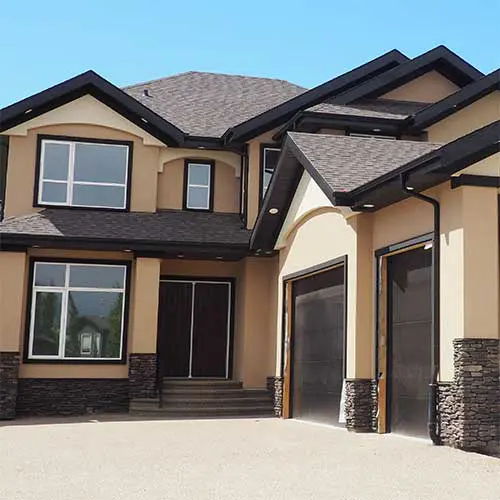
Why this topic belongs in a Castle Downs newsletter or a Big Lake builder blog
Griesbach’s 620 acre redevelopment by Canada Lands Company is a LEED ND pilot that emphasizes walkability and sustainable construction. EIFS aligns with that direction because it reduces heating energy and stabilizes indoor temperatures in Alberta’s winter. At the same time, Castle Downs carries a distinct Scottish castle naming pattern across its neighbourhoods. Much of that housing now reaches a point where exterior upgrades are due together. Swapping aging cement plaster walls for EIFS does more than refresh curb appeal. It lines up with the region’s energy and comfort targets. The shareable outcome is simple and local. The same houses that carried the castle theme for fifty years can cut air infiltration by up to 55 percent with an EIFS retrofit while preserving the look that makes Castle Downs recognizable from 153 Avenue to 97 Street.
What buyers should ask before signing
Rigid insulation and EIFS deliver energy savings only when detailing and sequencing are correct. Property owners looking for should ask about the water resistive barrier type, drainage path behind the foam, mesh weights at grade, weep screed placement, and sealant specifications at perimeters. They should see a written scope that calls out control joint locations and flashing tie ins. They should also verify material and workmanship warranty terms in writing. In Northwest Edmonton, those questions separate quotes that look similar on paper but perform differently on the wall once winter returns to T5T, T5X, T5Y, and T5W.
Where rigid insulation is not the right first move
There are cases where a full EIFS retrofit should wait. If a building has chronic roof leaks, bulk water can overwhelm any wall system. If a foundation shows active movement, cladding investment may be premature. If windows are near end of life, it is often better to replace windows first and then complete the EIFS so that the air barrier and flashing shingle correctly. A good contractor will explain these tradeoffs on site in Dovercourt, Kensington, or Prince Charles and prioritize work so owners see the best return.
Why matters across Edmonton’s mixed housing ages
Northwest Edmonton blends 1950s bungalows, 1970s and 1980s Castle Downs two stories, 1990s Palisades single family and townhome builds, and very recent Big Lake and Griesbach construction. That mix requires a contractor who works across cement plaster, acrylic stucco, EIFS, cement board stucco, parging, and decorative trim. Property managers who operate along Yellowhead Trail and Anthony Henday Drive do not have time to coordinate multiple trades for small envelope scopes. A team that handles the envelope from repair to full installation streamlines schedules and protects budgets through winter.
What owners near West Edmonton Mall and across T5T gain from rigid insulation
Homes and condos near West Edmonton Mall feel traffic, wind corridors, and frequent snow clearing. EIFS with continuous insulation calms interior temperatures during cold snaps when parking lot winds blow toward facades. Acrylic finishes resist grime and wash clean. Lower air infiltration helps furnace systems keep up with demand when doors open and close repeatedly. These effects are modest on paper yet large in daily comfort. They are the kind of steady improvements that reduce wear on heating equipment and make winter more livable without constant thermostat changes.
Scheduling and seasonality in Edmonton
Exterior insulation and finish work requires how to repair a cracked foundation small cracks dry conditions and temperatures above freezing for proper curing. Spring through fall offers the most reliable windows. In winter, projects proceed with temporary enclosures and heat. That adds cost. Owners on tight timelines along 97 Street or within the T5X and T5Y belts often choose to secure a spot early in the season so details and textures receive full attention without weather pressure. That planning also allows coordination with other trades such as window installers and electricians who handle exterior lights and service penetrations.
Final word on heating bills and EIFS in Northwest Edmonton
Rigid insulation systems change how walls work. They raise effective R value, seal air leaks, control condensation, and give finishes a stable base through Alberta’s freeze thaw cycles. In Northwest Edmonton, EIFS and acrylic stucco have become the standard way to do that. They match the design goals of Big Lake’s new homes and deliver real upgrades to Castle Downs and The Palisades houses that began without exterior foam. They also scale to commercial properties along 97 Street and 137 Avenue. Most important, they pay back where owners feel it, with steadier rooms and lower fuel use across the winter line that runs from Lois Hole Centennial Provincial Park to downtown Edmonton.
Book with a local contractor who does the envelope right
Depend Exteriors serves Northwest Edmonton from its headquarters in T5T with fast routing via Anthony Henday Drive and Yellowhead Trail. The team handles EIFS installation, EIFS repair, acrylic stucco installation, stucco replacement, parging, exterior caulking, and full stucco inspections with moisture mapping and substrate repair when needed. The company is family owned and operated by Hasan Yilmaz, Alberta licensed and bonded, carries liability insurance, and has been operating in Edmonton for more than 13 years with 15 years of hands on exterior finishing expertise in this climate. Manufacturer backed material warranties on EIFS systems and a workmanship warranty on installation labour are provided on eligible projects. Free estimates come with a transparent written quote and clear scope. Six day scheduling with extended hours, Monday through Friday 8 AM to 7 PM and weekends 8 AM to 3 PM, makes site visits straightforward across Castle Downs, Big Lake, The Palisades, Griesbach, and the full T5X, T5Y, T5W, and T5T postal code areas. Property owners ready to move forward with can call +1-780-710-3972 or request a site visit online to confirm scope, textures, and timelines.